Sir John Key Destroyed New Zealand’s Democracy.
 Published 18/12/2025 |

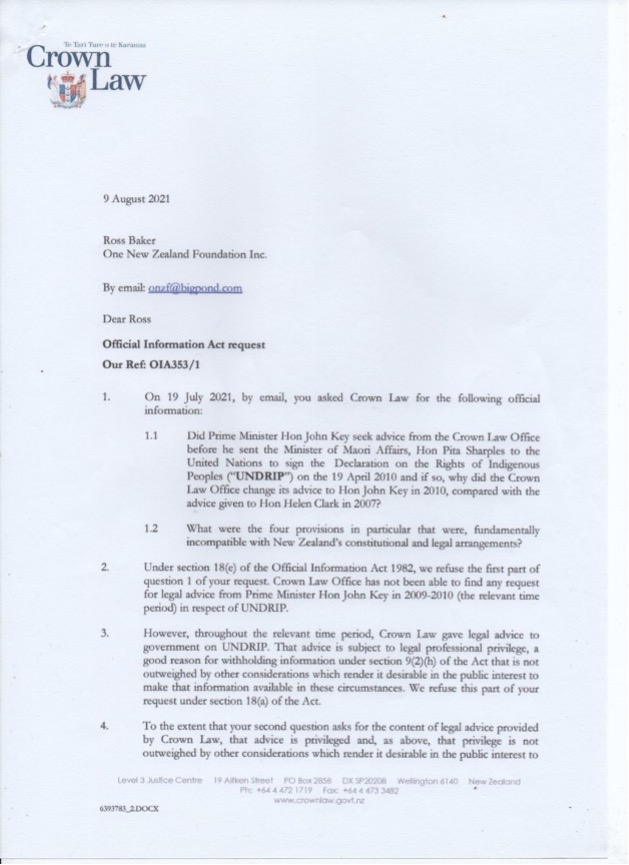
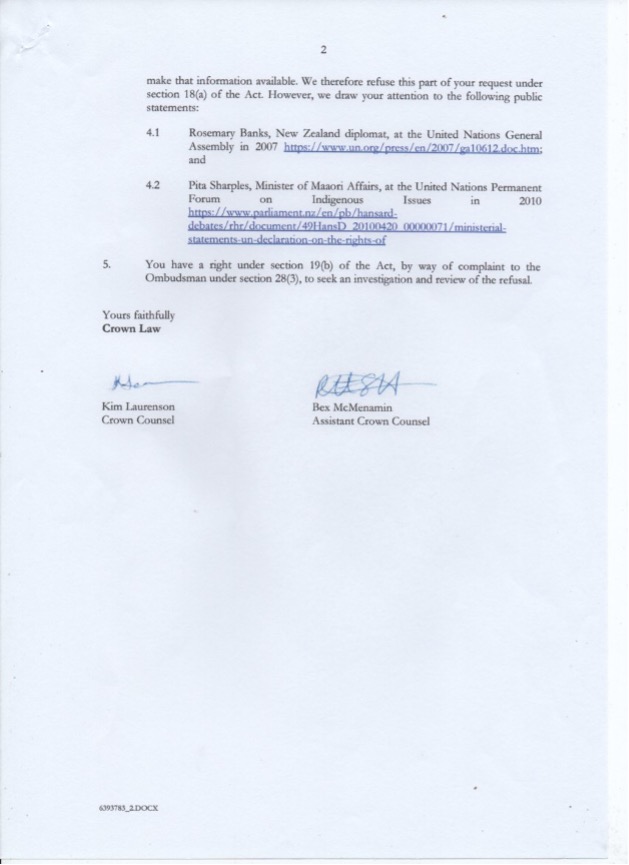
On 13 September 2007, Rosemary Banks, New Zealand’s Permanent Representative to the United Nations explained to the United Nations the reason why New Zealand could not sign the Declaration of the Rights of the Indigenous People stating, “It was fundamentally incompatible with New Zealand’s constitutional and legal arrangements”, but this was completely ignored by the United Nations when the Hon Pita Sharples signed the Declaration on the 19 April 2010. WHY?
In 2007, Maori asked Prime Minster, Hon Helen Clark to sign the United Nations Declaration on the Rights of the Indigenous People, but New Zealand does not have a definition of the Indigenous People of New Zealand as well as, “Four provisions of the Declaration were fundamentally incompatible with New Zealand’s constitutional and legal arrangement”, therefore, she refused to sign it.
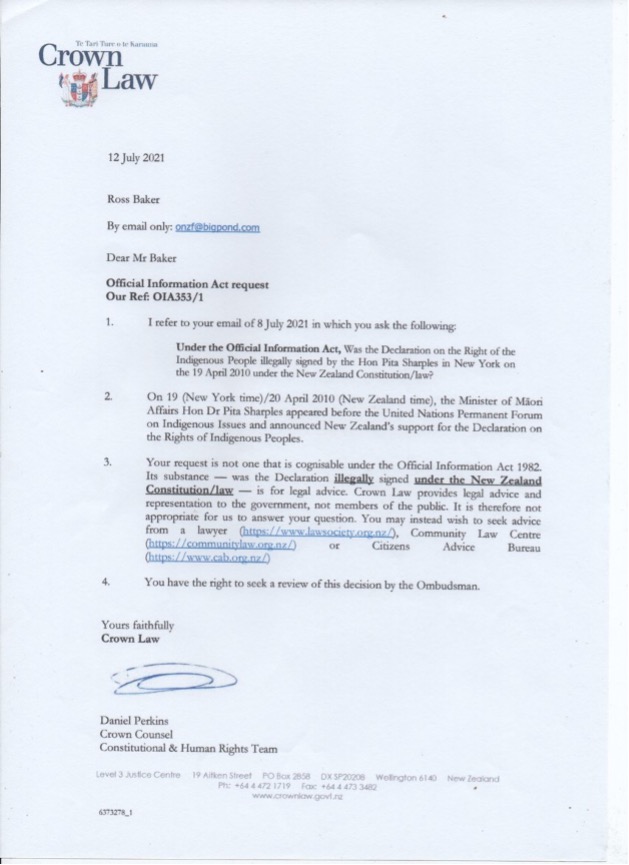
In 2010, Prime Minister Hon John Key sent the Minister of Maori Affairs, the Hon Pita Sharples to New York on 19 April to sign the United Nation’s Declaration of the Rights of the Indigenous People in secret!
Hon John Key must have known, Rosemary Banks, New Zealand’s Permanent Representative to the United Nations had explained to the United Nations the reason why New Zealand could not sign the Declaration of the Rights of the Indigenous People, why Hon Helen Clark had not signed the Declaration in 2007 and that New Zealand did not have a definition of the Indigenous people of New Zealand, but he went ahead and signed it in secret without a mandate from Parliament or the people of New Zealand. We believe this was solely for John Key to gain the Maori vote to stay in power as Prime Minister.
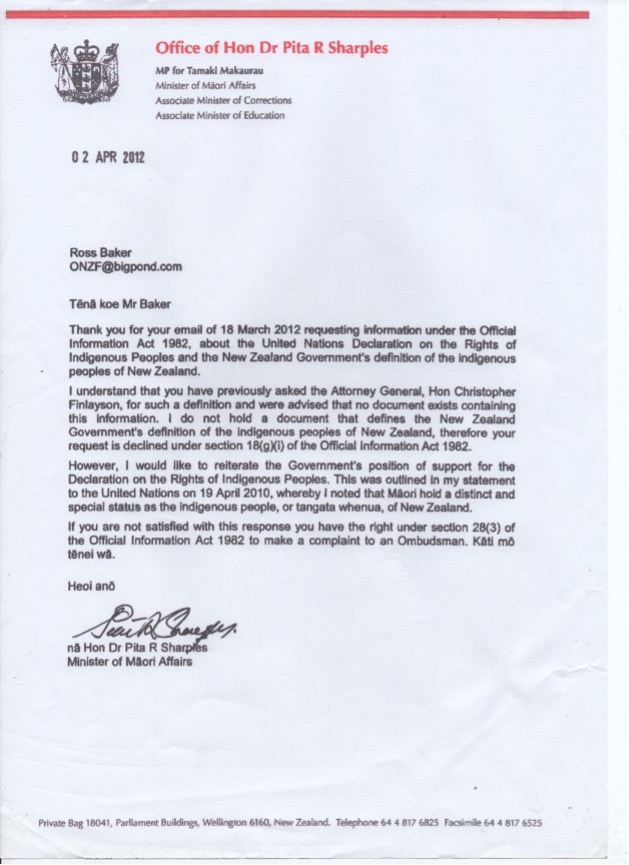
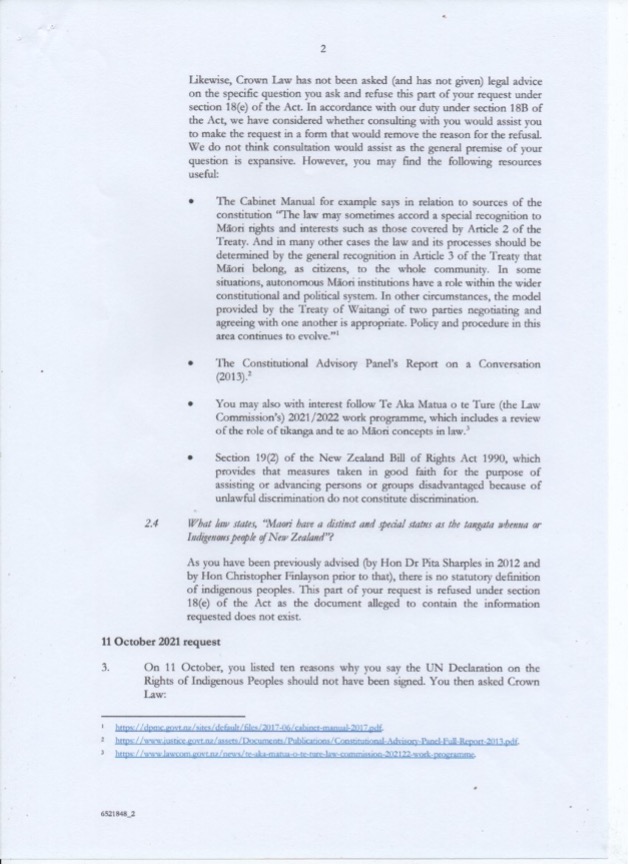
You will see from the OIA letter from Hon Pita Sharples below dated 2 April 2012, before he signed the Declaration, he told the United Nations, “Maori hold a distinct and special status as the indigenous people, or tanga whenua of New Zealand”. It is obvious Hon Pita Sharple’s knew, Maori are NOT the indigenous people, or tangata whenua of New Zealand, otherwise he would have stated, “Maori are the indigenous people, or tangata whenua of New Zealand”, but the United Nation’s accepted it.
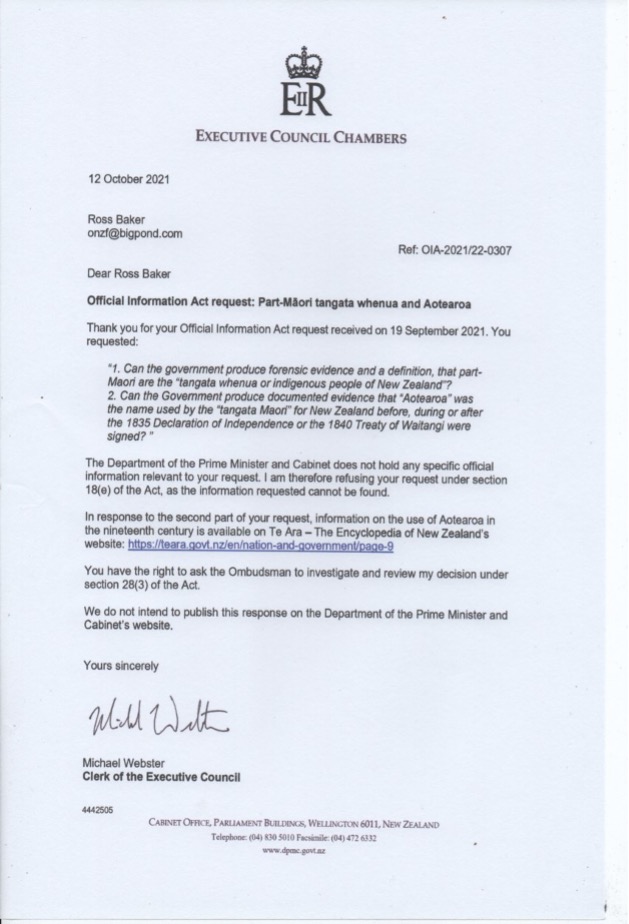
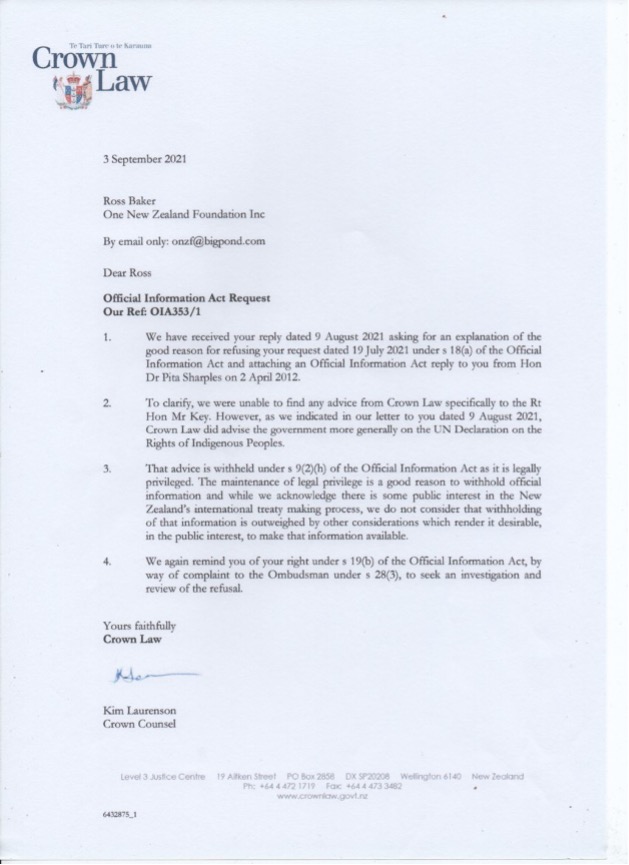
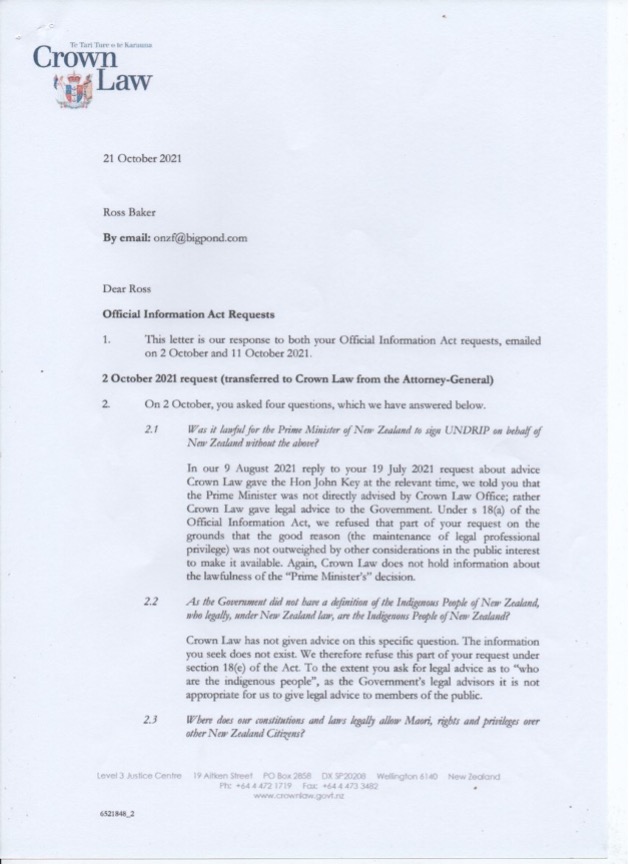
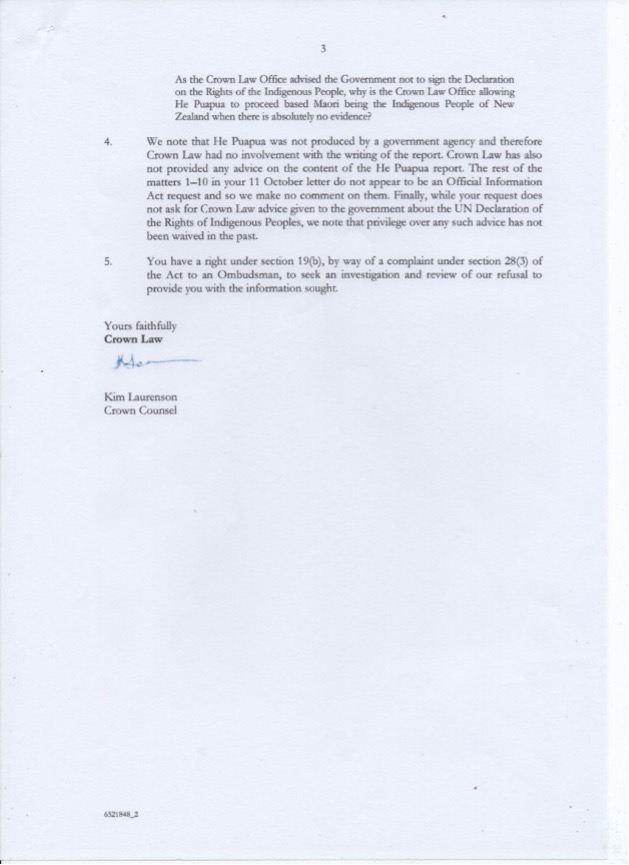
On 21 October 2021 in an OIA letter to the Crown Law Office, 2.4, we asked, “What law states, Maori have a distinct and special status as the tanga whenua or indigenous people of New Zealand”. The Crown Law Office replied, “You have been previously advised (by Hon Pita Sharples in 2012 and by Hon Christopher Finlayson prior to that), there is no statuary definition of indigenous people. This part of your request; (What law states, Maori have a distinct and special status as the tanga whenua or indigenous people of New Zealand), is refused under section 18(e) of the Act as the document alleged to contain the information requested does not exit”. Hon Pita Sharples lied to the United Nations.
By their own admission, the tangata Maori arrived in New Zealand by canoe in the 14th century to find New Zealand already inhabited by the tangata whenua.
As there is no statuary definition of the indigenous people of New Zealand and the document alleged to contain this information requested does not exit, then the United Nations accepted Maori as the Indigenous People, or tangata whenua of New Zealand, when New Zealand does not have a definition that Maori are in fact, “The Indigenous People of New Zealand”.
The Declaration on the Rights of the Indigenous People has given Maori special rights over all other New Zealand Citizens, allowing Maori, “A Partnership with the Crown” and possibly, “Co-Governance with the Crown”, based on the United Nations allowing Hon Pita Sharples to sign the Declaration without a definition of the indigenous people of New Zealand and completely ignoring New Zealand’s Permanent Representative to the United Nations, Rosemary Bank’s explanation in 2007, why it could not be signed.
The National Government then spent $7.2 million of taxpayer’s money to build the He Tohu Exhibition to house the Declaration of Independence and the Treaty of Waitangi to mislead the people, stating, “The Declaration of Independence and the Treaty of Waitangi are Iconic constitutional documents that shaped Aotearoa New Zealand”. The Declaration of Independence was a complete failure as James Busby could only entice 52 chiefs to sign it, and the Treaty of Waitangi only referred to the tangata Maori making them British Subjects with, “The same rights as the people of England if they gave up their kawanatanga/governments to the Queen”. In fact, the Treaty of Waitangi is not a treaty as it was only signed by one Sovereign Nation, Great Britain.
Queen Victoria’s Royal Charter/Letters Patent date the 16 November 1840 is New Zealand’s true Founding Document as it made New Zealand into a British colony with a Governor and Constitution, that set up New Zealand’s political, legal and justice systems under one flag and one law, irrespective of race, colour or creed, a British Colony under one flag and one law, irrespective of race colour or creed. See:
There is no other document in our history that comes anywhere near to a Founding Document than Queen Victoria’s Royal Charter/Letters Patent dated 16 November 1840!
The Government has no other option now, than to inform the United Nations, New Zealand does not have a definition of, “The Indigenous people or tangata whenua of New Zealand”, and they were informed in 2007 by Rosemary Banks, New Zealand’s Permanent Representative to the United Nations, “It was fundamentally incompatible with New Zealand’s constitutional and legal arrangements”, which has completely destroyed New Zealand’s democracy as agreed by the Treaty of Waitangi in 1840 and Queen Victoria’s Royal Charter/Letters Patent dated 16 November 1840, New Zealand true Founding Document.
Ministerial Statements on the UN Declaration on the Rights of Indigenous Peoples.
Tuesday, 20 April 2010
HON RODNEY HIDE: (Act Party Leader)
The ACT Party is both shocked and appalled to find itself supporting a government that has covertly given recognition to the United Nations Declaration on the Rights of Indigenous Peoples. The declaration asserts that Māori have rights and privileges not enjoyed by other New Zealanders. The declaration is the very antithesis of ACT’s policy of one law for all New Zealanders. It is the antithesis of the policy that we should have one law regardless of people’s religion, their race, the colour of their skin, their ethnicity, their culture, or indeed their degree of indigeneity. The declaration is divisive and is a further step for New Zealand down the path towards being a divided nation. The declaration clearly splits New Zealand into two rather than bringing New Zealand together as one.
For many the former Prime Minister, Helen Clark, refused to ratify the declaration. At the time, the Hon Parekura Horomia said that the declaration was incompatible with New Zealand’s laws and democratic processes and that it ignored reality and would be difficult to implement.
I am very disappointed that the Prime Minister, John Key, has covertly foisted the declaration on New Zealand, and I consider the statement that the recognition of this declaration has no practical effect to be naive in the extreme.
Hon JIM ANDERTON (Progressive Party Leader)
Well, which meaning did the Government sign up to? Did it not know? Has the Government read it? Does it know what it means? The answer to all those questions is no. It has nothing to do with it. It is to do with the deal between National and the Māori Party to get the Māori Party to run alongside and support the Government.
Hon Phil Goff (Leader Labour Party)
The declaration was signed in secrecy when Dr Sharples had “sneaked off” to New York. New Zealanders should have been told first that this was the intention of the Government, they should not have been told afterwards. There was a conflict between Dr Sharples’ view of the declaration and the Government’s position about it not making any practical difference. Labour had opposed the declaration which had unrealistic goals such as returning all land back to indigenous people. I could not see the point in signing up to a declaration that the Government did not intend to fulfil. Why would you sign up to something you never intended to act on, and you don’t believe in. He signed up to something they do not believe in and never intend to implement. Prime Minister Helen Clarke, Labour, refused to sign the Declaration in 2007 as it contravened our Constitution, but John Key was quite happy to destroy our democracy as long as he could become, Prime Minister, “Sir John Key”.
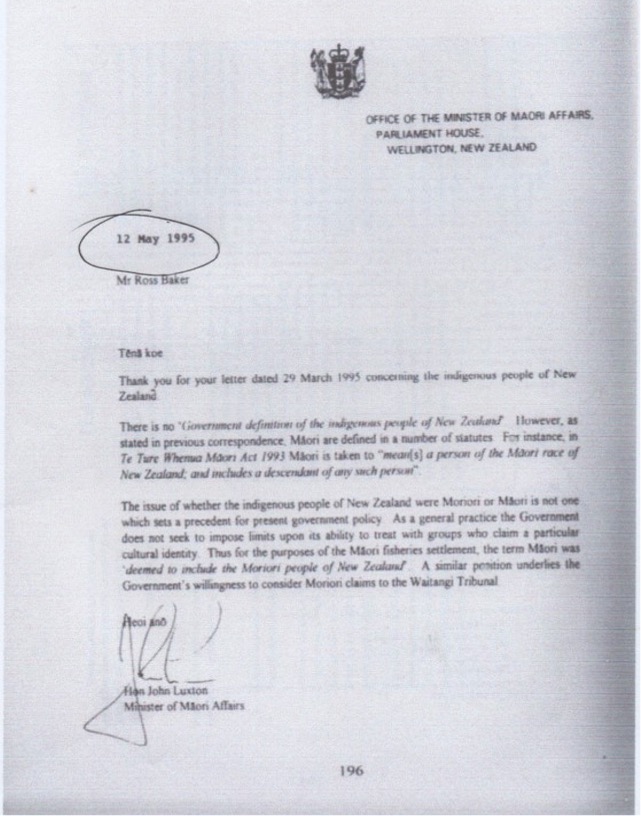
New Zealand does not have, A Definition of the Indigenous People of New Zealand.
This article was written from documents held in the New Zealand, Australian and American Archives, plus the British Parliamentary Papers and Official Information Act letters received by the ONZF.
Website: www.onenzfoundation.co.nz. Email: ONZF@bigpond.com.au.